
The Cinematic Feature: TV Wall Design Trends for 2026
The Cinematic Feature: TV Wall Design Trends for 2026
The hearth of the modern home has moved. It is no longer found in the crackle of a wood-burning fireplace or the shared warmth of a kitchen stove; it has migrated to the glow of the screen. We gather there to escape, to learn, to weep over stories, and to reconnect after the fragmented chaos of our days. Yet, for too long, we have treated the television as a cold, black intrusion a functional necessity that interrupts the harmony of our sanctuaries. We hang it on a bare wall like an afterthought, a glass void that stares back at us when the power is cut.
In 2026, we are finally asking more of our homes. We are realizing that the spaces where we spend our most intimate hours curled under a throw on a rainy Tuesday or hosting a vibrant Friday night deserve more than a “black box” on a bracket. The evolution of the TV wall is, at its core, an act of reconciliation. It is about merging the cutting-edge pulse of technology with the timeless, grounding textures of the earth. It is about taking the cold glass of a screen and cradling it in the warmth of walnut slats, the ancient strength of marble, and the soft, ethereal glow of hidden light.
A well-designed TV unit is a love letter to the way we actually live. It understands that we need beauty when the screen is dark and immersion when it is bright. It respects the quiet of a bedroom, the energy of a living room, and the cleverness required of a small apartment. When we design these walls, we aren’t just building a shelf or choosing a stone; we are framing the window through which we view the world. We are creating a backdrop for the memories that happen in front of it the late-night conversations, the children’s laughter, and the silent, peaceful moments of rest.
This is the art of “Invisible Luxury”: a design so thoughtful that the technology disappears, leaving behind nothing but an atmosphere that feels, quite simply, like home.
Below is a detailed breakdown of 30 unique concepts categorized by their design DNA.
The Stone & Mineral Series: Raw Luxury
For living rooms that demand a “High-End Hotel” or “Villa” aesthetic.
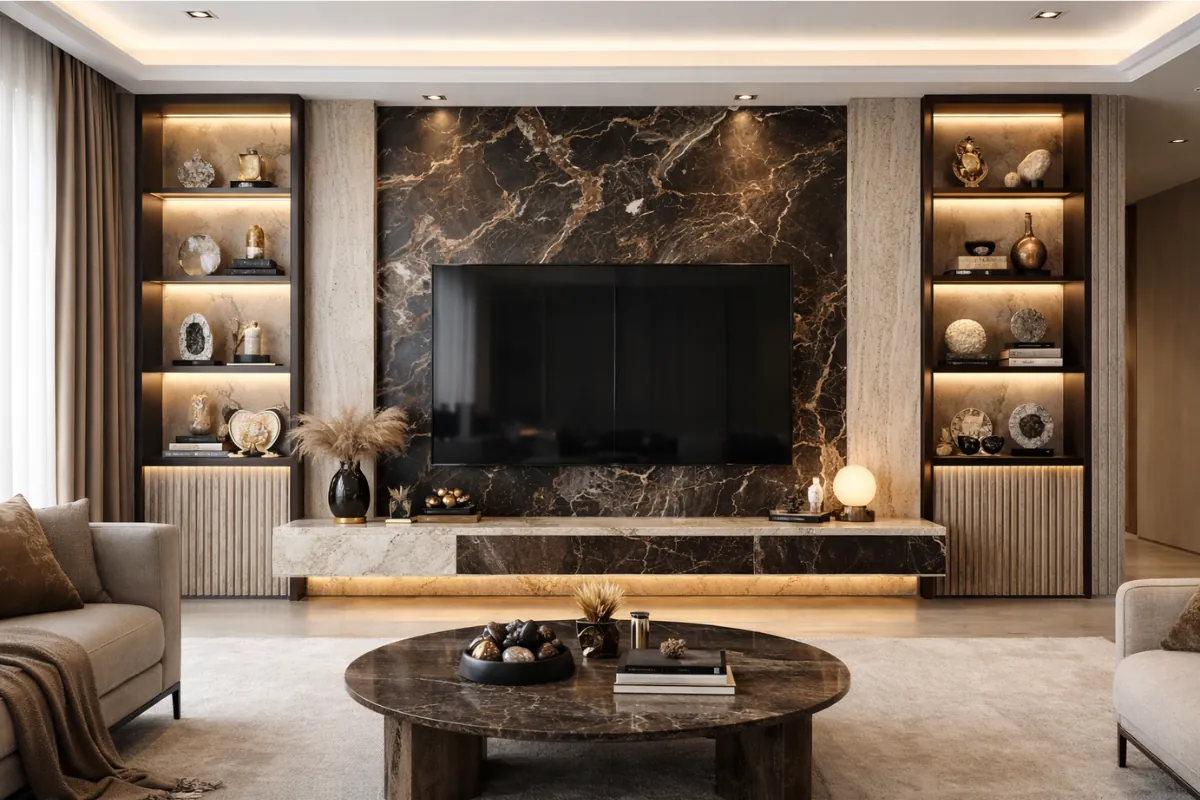
- Book-Matched Statuario Marble: Two massive slabs meeting at a center seam. The TV is recessed into the stone so the screen surface is perfectly flush with the marble.
- Backlit Translucent Onyx: A semi-precious stone panel with internal LED sheets. When off, the stone glows softly; when on, it provides the ultimate “bias lighting” to reduce eye strain.
- Travertine Fluted Panels: Scalloped limestone tiles that provide a matte, sandy texture. This is the 2026 “Quiet Luxury” staple—neutral, tactile, and expensive-looking.
- Charcoal Slate Waterfall: Dark, rugged slate that begins on the ceiling, “waterfalls” down the TV wall, and becomes a low-profile floor ledge.
- Pockmarked Industrial Concrete: Large-format concrete panels with brass “inlay” strips between the joints for a refined urban-loft look.
- Silver Birch Log-Effect Recess: For homes with a fireplace, a vertical “wood stack” niche placed symmetrically next to a stone-clad TV wall adds organic warmth.
The Timber & Texture Series: Warm Minimalism
For bedrooms and “Japandi” inspired spaces where comfort is king.
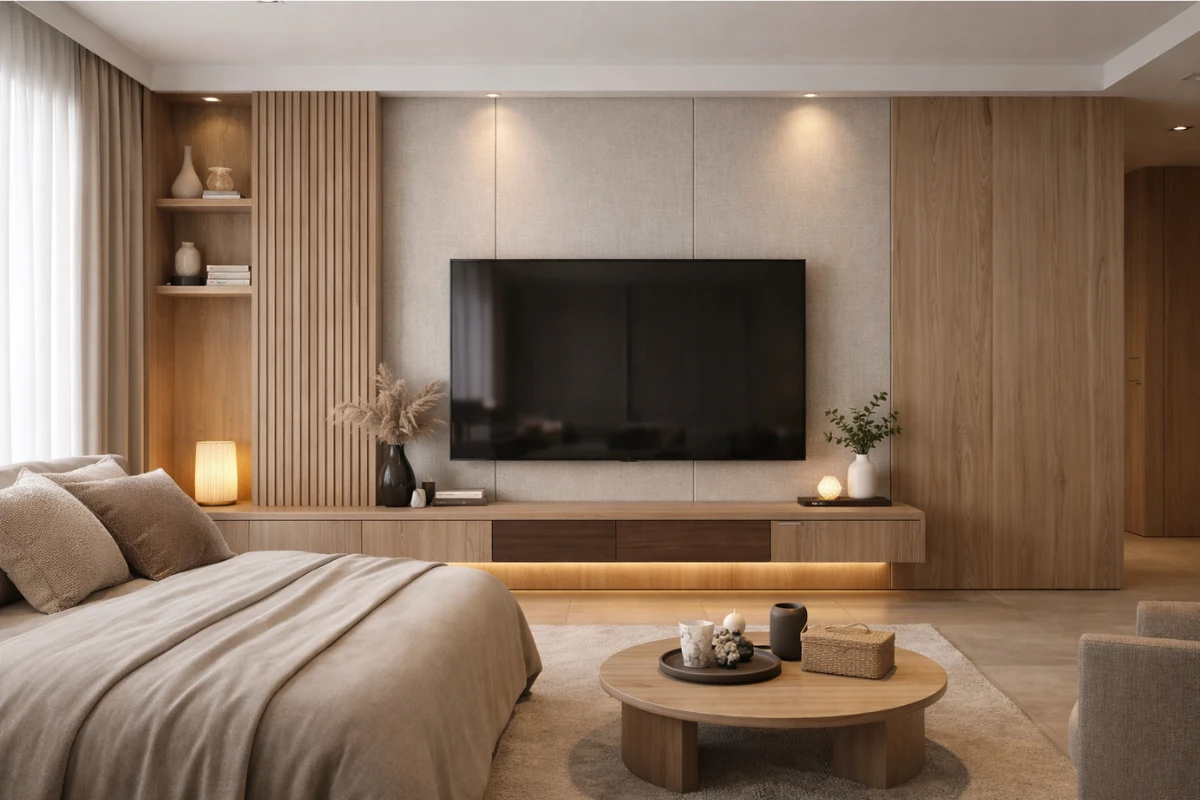
- Micro-Slat Walnut Walls: Ultra-thin (10mm) walnut slats with black felt backing. This design doubles as an acoustic treatment, making your soundbar sound 40% richer.
- The “Shou Sugi Ban” Backdrop: Charred black wood panels that make the black TV screen completely disappear when it’s switched off.
- Herringbone Oak Cladding: A traditional floor pattern brought to the wall. Pair this with a floating white lacquer console for a “Modern Classic” look.
- Louvered Wood Doors: A “hidden TV” concept where the screen is tucked behind beautiful, slatted folding doors that look like architectural paneling.
- Woven Rattan Inlays: Panels of natural rattan framed by dark oak—perfect for a coastal luxury or “Bohemian Chic” bedroom.
- The 3D “Pyramid” Wood Wall: Sculptural wood blocks of varying depths that create a mesmerizing play of shadows when hit by side-lighting.
The Architectural & Geometric Series: Structural Depth
Using the “shell” of the room to create built-in luxury.
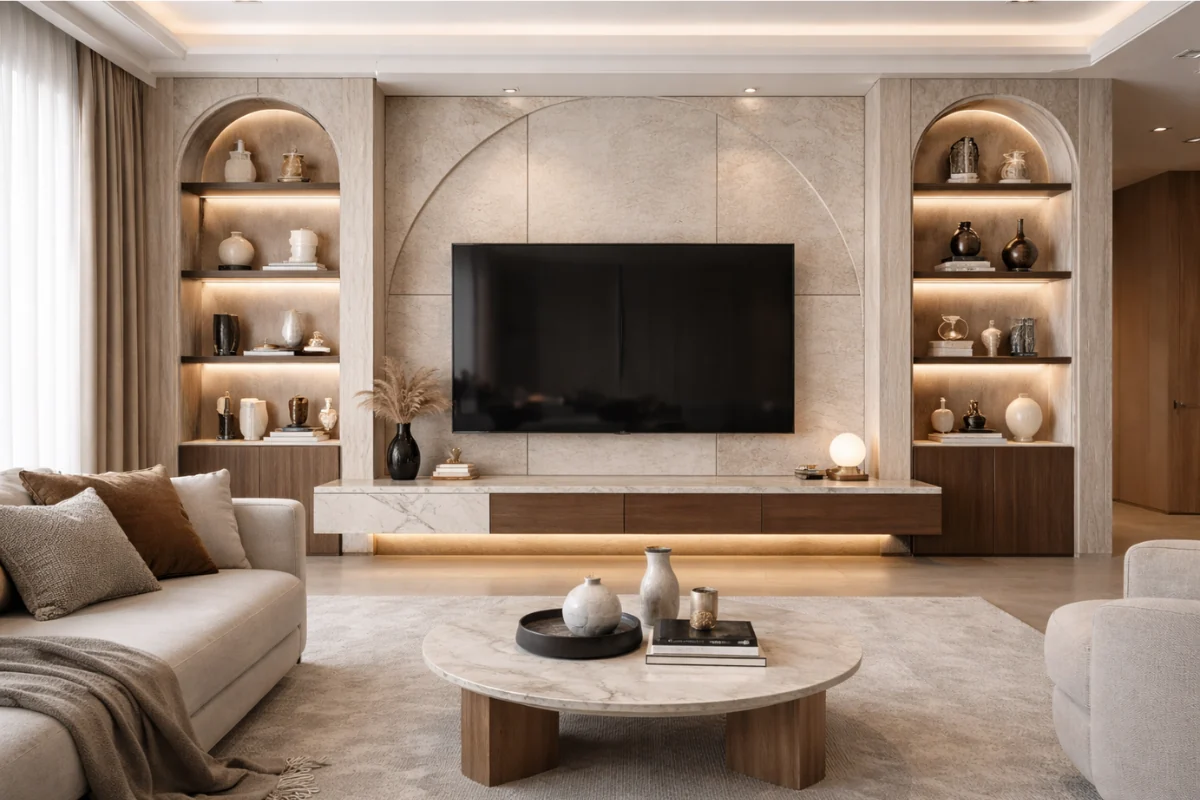
- The Soft Radius Arch Niche: A deep, arched alcove painted in a contrasting color (like terracotta or sage). The TV sits deep inside, framed by a soft “halo” of light.
- Double-Height Statement Wall: For villas with high ceilings, vertical panels that go from floor to ceiling, using “shadow gaps” every 2 meters to add rhythm.
- The Floating “Box-in-Box” Design: A dark-toned box (holding the TV) nested inside a larger, lighter-toned stone or plaster frame.
- Asymmetrical Floating Shelves: A long horizontal ledge beneath the TV that extends 2 meters past the screen, balanced by a single vertical bookshelf on the opposite side.
- The Cantilevered Stone Ledge: A thick (15cm) marble shelf that appears to float with no visible supports, housing the soundbar and remote-control sensors.
- The Corner-Wrap Slat Design: Vertical slats that wrap around a corner, allowing a TV to be mounted on a “diagonal” for difficult living room layouts.
The Invisible & Artful Series: Tech-Forward Discretion
For those who want the functionality of a TV without the “Black Box” look.
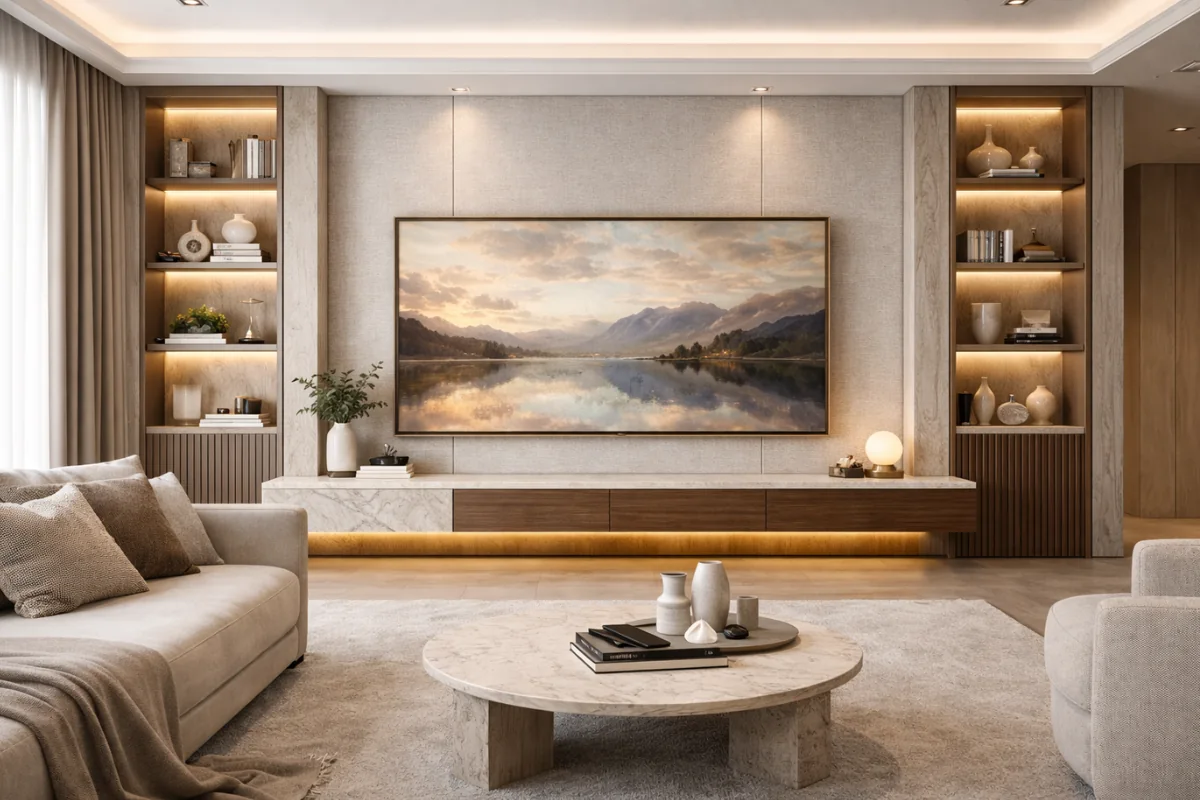
- The Art Gallery Salon Wall: Surround the “Frame” style TV with 10–12 mismatched vintage gold frames. The TV becomes just another piece of art.
- Sliding Canvas Panels: A large-scale piece of art that splits in the middle and slides open via remote to reveal the screen.
- Mirror-Tech Integration: A 2-meter tall floor-to-ceiling mirror. When the TV is off, it’s a high-end dressing mirror; when on, the image magically appears through the glass.
- The Monochrome Black-Out: A matte black “Limewash” wall where the TV, the speakers, and the console are all matte black. It’s ultra-minimal and incredibly cinematic.
- Wallpaper Camouflage: A bold, dark floral mural. The intricate patterns of the wallpaper mask the rectangular silhouette of the television.
Small Space & Multi-Functional Series: Smart Geometry
For urban apartments and dual-purpose rooms.
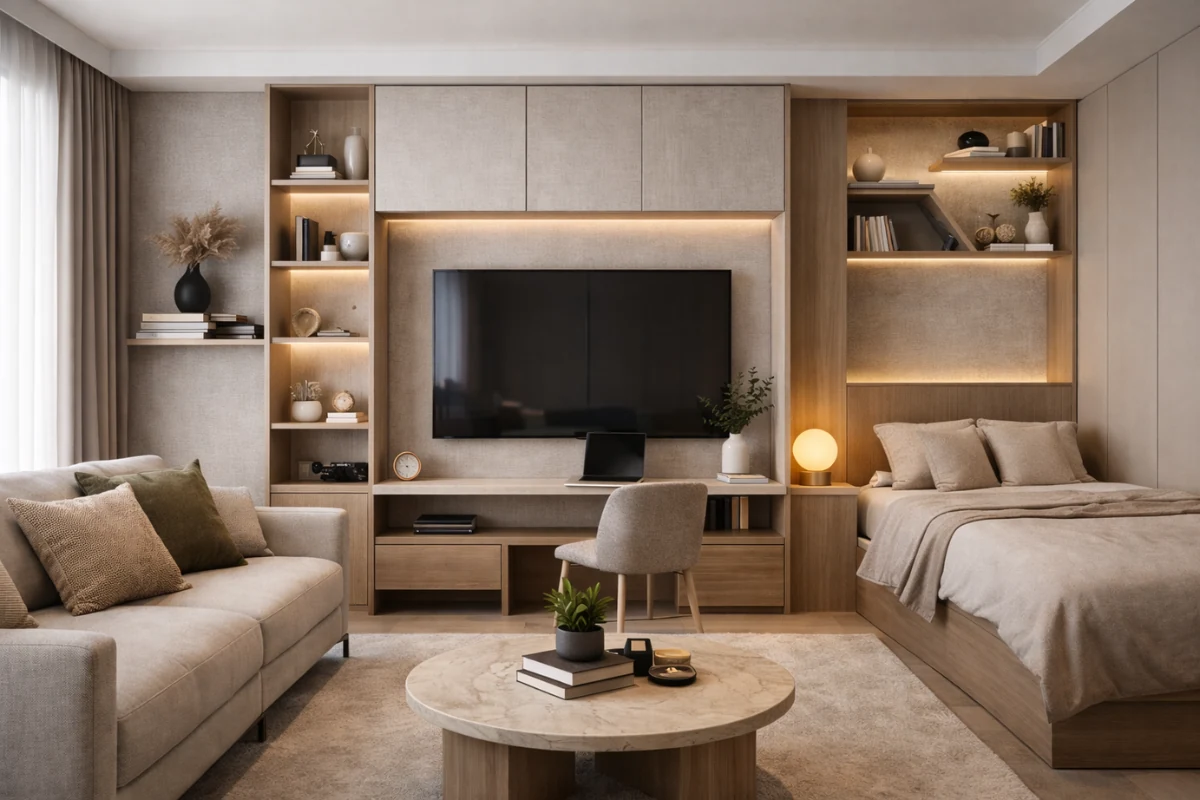
- The TV + Office Hybrid: A full-wall unit where the floating TV console seamlessly transitions into a 1.2-meter home office desk.
- The Room-Divider TV Wall: A “floating” wall that doesn’t touch the ceiling. It holds the TV on one side and a bookshelf or vanity on the other.
- Vertically Stacked Niches: Using the vertical space above the TV for decor and the space below for “push-to-open” toy or tech storage.
- The Mirror-Backed Bookshelf: Using mirrors behind open shelves flanking the TV to bounce light and make a narrow room feel twice as wide.
- Retractable Ceiling Mount: For ultra-small bedrooms, a TV that folds into a “pocket” in the false ceiling, leaving the walls completely bare.
- The “Puddle” Shelf: An organic, kidney-shaped floating shelf that mimics the “curved” trend of 2026, softening a small, boxy apartment.
- Magnetic Panel Walls: A modular wall system where you can “snap” on shelves or cable-management covers wherever you need them.
The 2026 Technical Masterclass: 3 Non-Negotiables
1. The "Invisible" Standard
In 2026, cable management is not an option; it is a requirement. A luxury TV wall design must have in-wall conduits. If you are using a stone or wood veneer, build a “sub-frame” 4 inches off the main wall to allow for device ventilation and wire “chasers.”
2. Bias Lighting & The "Halo" Effect
Direct overhead light creates glare. The 2026 look uses 6500K LED strips placed 2 inches behind the screen or the feature panel. This reduces eye strain and provides that “floating” architectural depth that defines high-end interiors.
3. The Ergonomic Height (The 105cm Rule)
The biggest mistake in TV wall design is mounting the screen too high (“The Fireplace Trap”). For a standard sofa height, the center of the screen should be exactly 105cm to 110cm from the floor. This aligns with the human eye-line, preventing neck fatigue over long viewing sessions.








some really great blog posts on this site, appreciate it for contribution.