The Science of Invisible Volume: A Precision Guide to Smart Storage solution
The Science of Invisible Volume: A Precision Guide to Smart Storage solution
In the golden age of architecture, luxury was defined by the sheer abundance of space. Today, in the era of high-density urban living and curated minimalist aesthetics, luxury has been redefined. It is no longer about how much space you own, but how masterfully you command it. We are witnessing a fundamental shift in interior philosophy: moving away from the era of “adding furniture” toward a sophisticated future of “engineering volume.”
For the modern family, the home is no longer just a place of rest; it is a multi-functional hub a classroom, a high-tech office, and a sanctuary. The challenge is that as our lives become more complex, our physical belongings threaten to overwhelm the “theme” of our homes. Whether you are inhabiting a high-efficiency 1BHK or a sprawling, theme-based independent villa, the ultimate goal of premium design is Visual Silence. Visual Silence is the art of creating a home where every object has a precise coordinate, yet no storage unit is visible to the naked eye. It is the bridge between a cluttered reality and a high-end, magazine-ready aesthetic. By treating storage as a structural element rather than a decorative add-on, we can reclaim our living spaces.
1. The 1BHK: Kinetic & Vertical Optimization
In a 1BHK (approx. 450–650 sq. ft.), storage must be multi-modal. You do not have the luxury of dedicated rooms, so furniture must perform “double duties.”
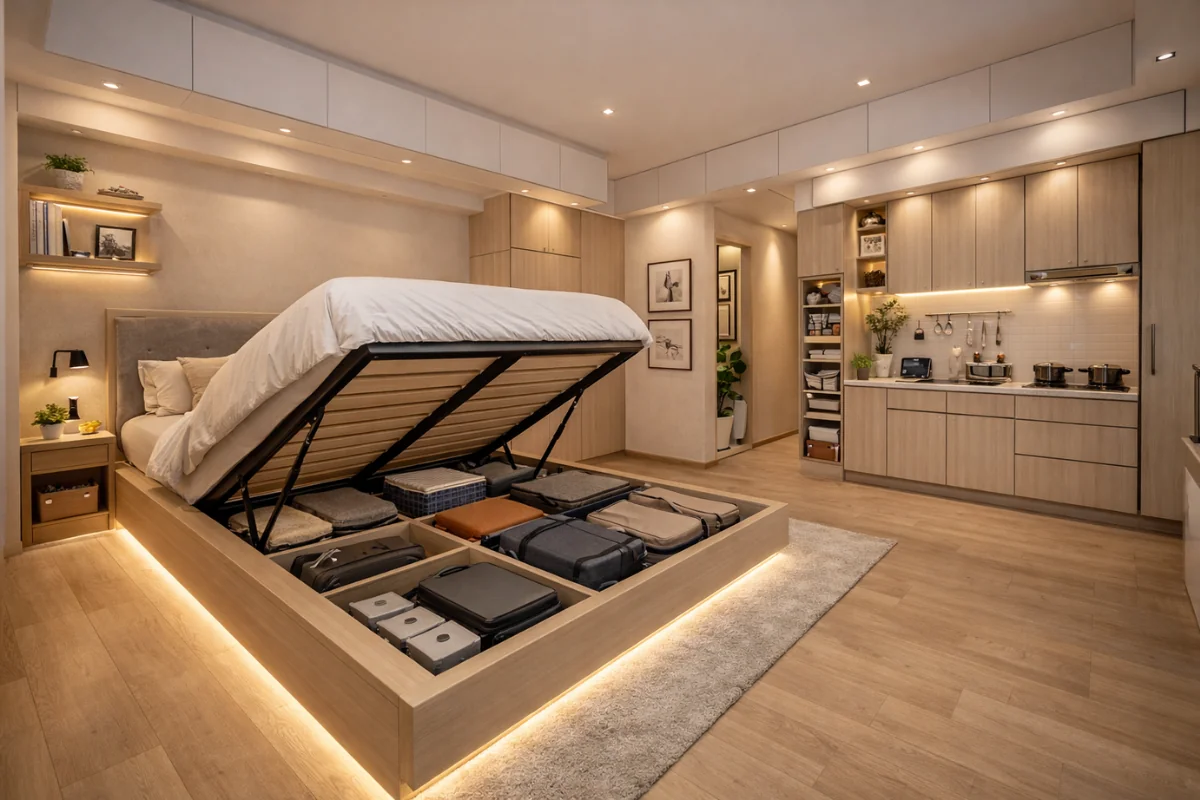
- Precision Detail: The “Living Platform.” Instead of a standard bed frame, engineer a 15-inch raised floor in the bedroom. This creates a massive horizontal “basement” for suitcases and bulky items.
- The Invisible Hack: Use ceiling-integrated loft systems that follow the perimeter of the hallway. Clad them in the same material as the ceiling with push-to-open latch systems to eliminate handles, making them look like a dropped architectural soffit.
- Kitchen: Extend cabinetry to the absolute ceiling. Use the highest tier for items used once a year (festive decor/large pots).
Check out our recent blog about bedroom wardrobe storage solution
2. The 2BHK: The "Buffer Zone" Strategy
The 2BHK (800–1200 sq. ft.) usually houses small families. The primary challenge is the entryway and the transition zones.
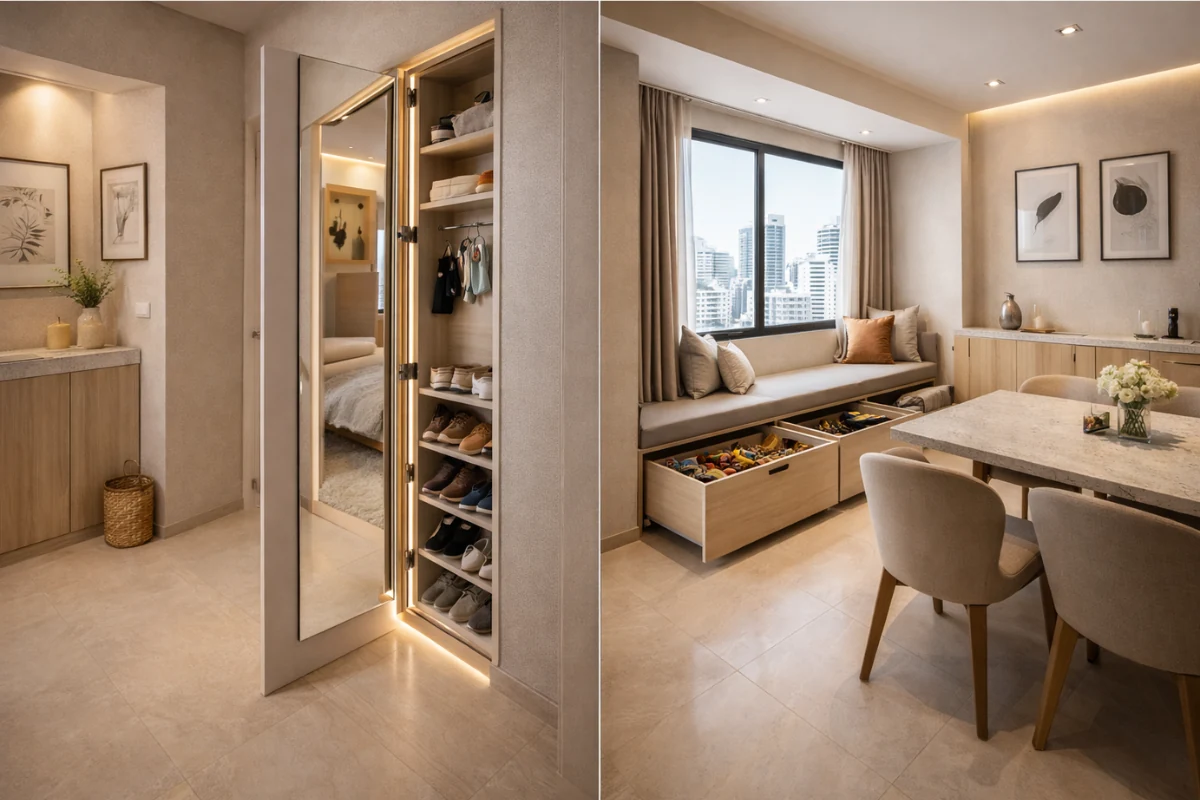
- Precision Detail: The “Foyer Command Center.” Install a full-height mirror in the entryway. This mirror should be a 10-cm deep door on a piano hinge, hiding a “drop zone” for keys, mail, masks, and shoes.
- The Invisible Hack: Window Bay Integration. Instead of leaving the space under windows empty, build a custom “Box Bench.” The exterior should match the wall color, while the top serves as a reading nook. Inside, use heavy-duty drawer slides for toy storage or shoe collections.
- Dining Area: Incorporate a credenza built into the wall. Use a stone-top finish that matches the dining table to make it look like a decorative ledge rather than a cabinet.
3. The 3BHK: Zoning & Concealed Workspaces
In a 3BHK (1300–2200 sq. ft.), storage must address the “Work From Home” (WFH) reality and “Guest Readiness.”
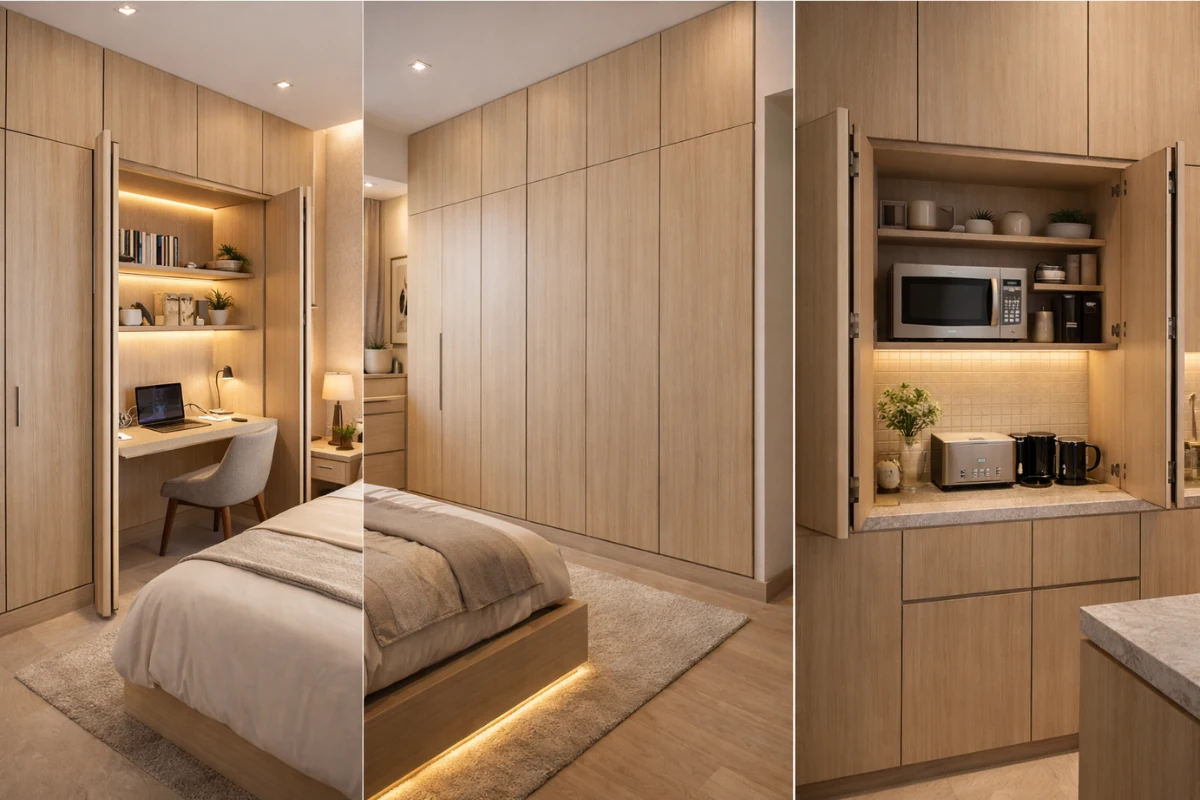
- Precision Detail: The “Pocket Office.” In the guest room or living area, design a wardrobe section with pivot-slide doors. When open, it’s a fully functional desk with tech-integration; when closed, it is a seamless wooden panel that matches the room’s cabinetry.
- The Invisible Hack: Floor-to-Ceiling “Monolith” Wardrobes. Avoid “wardrobe-over-loft” designs which create horizontal lines. Use single-panel doors (up to 9 feet) with internal stiffeners. This creates a monolithic, architectural look that feels like a wall rather than a cupboard.
- Kitchen: Implement a “Butler’s Pantry” or an “Appliance Garage.” Use bi-fold doors to hide the microwave, toaster, and coffee machine, keeping the primary countertops completely clear.
4. Villas & Independent Houses: Material Continuity
In premium, theme-based villas (3000+ sq. ft.), storage is about preserving the theme. You aren’t just hiding a mess; you are hiding the “utility” of the house.
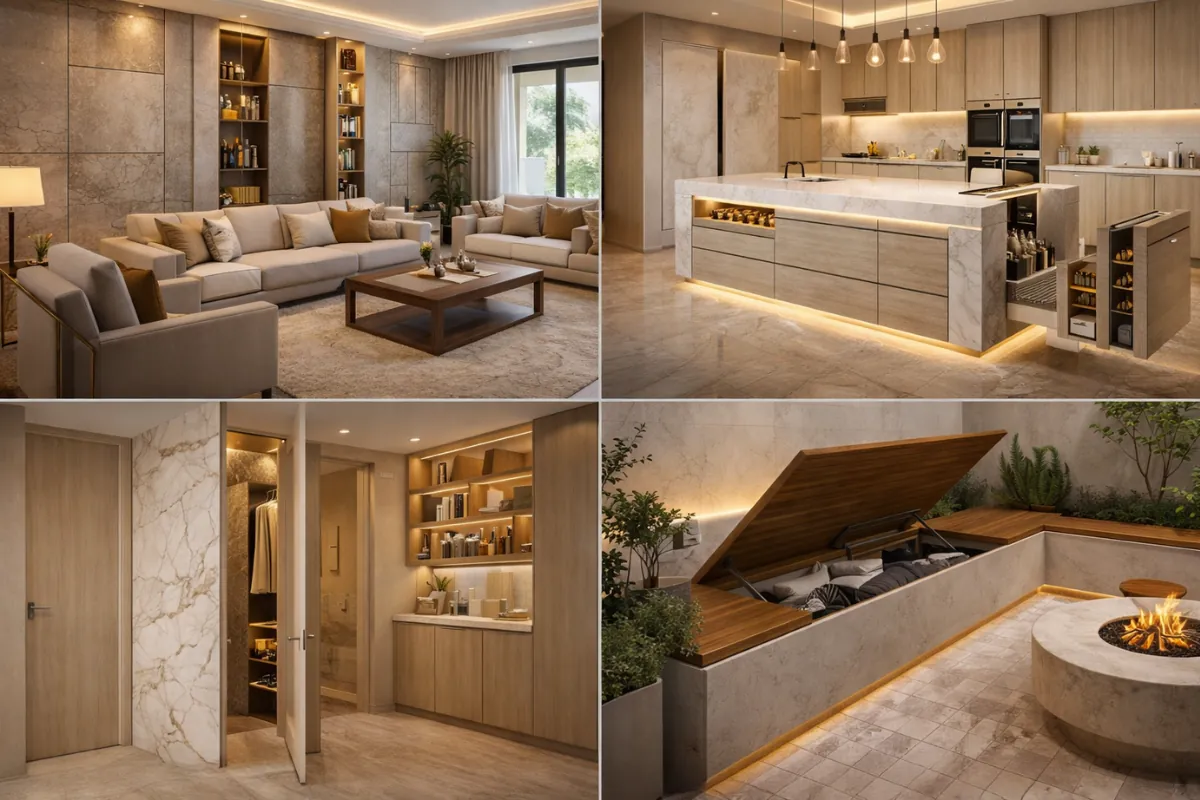
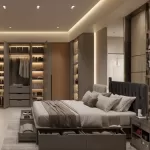
- Precision Detail: The “Hidden Passage.” In master suites, use a Jib Door (a door that is flush with the wall and has no visible frame) that leads to a walk-in closet. The wall continues its pattern (fluted wood, wallpaper, or stone) across the door, making the storage room entirely secret.
- The Invisible Hack: Staircase Engineering. In independent houses, the “void” under the staircase is often wasted. Convert this into a climate-controlled wine cellar or a library. Use tinted glass and internal LED strips to make it a design feature rather than a storage box.
- Utility Zones: Create a “Wet & Dry” kitchen split. The dry kitchen (visible to guests) features high-end stone and zero clutter, while all heavy cooking and storage happen in the “Wet Kitchen” hidden behind a disguised door.
To achieve “Visual Silence,” the hardware is just as important as the woodwork. The goal is to eliminate visual clutter like handles and hinges while ensuring the kinetic experience (the way a door opens and closes) feels premium and effortless.
Here is the precision hardware guide for engineers, designers, and homeowners.
The Visual Silence Hardware Guide: The Engineering of Invisibility
1. The "No-Handle" Revolution: Push-to-Open & Touch Systems
To make a wardrobe or cabinet look like a wall, you must eliminate external handles.
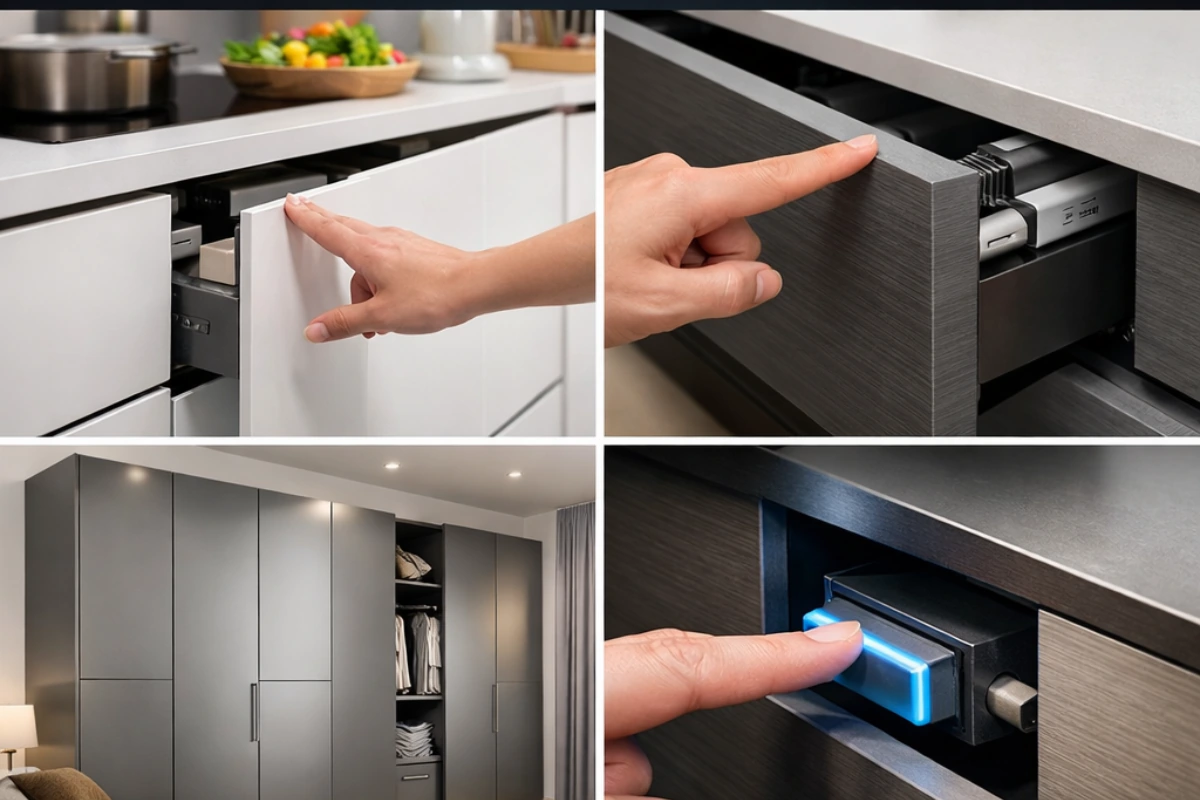
- Mechanical Push-Latches (e.g., Blum TIP-ON): These allow doors to open with a light touch.
- Precision Tip: Use the “Long Version” for larger wardrobe doors to ensure enough “throw” for you to grip the door edge easily.
- Servo-Drive (Electronic): For high-end villas, electronic drive systems open drawers and lift-up cabinets with a single tap. They are essential for heavy, wide drawers that mechanical springs might struggle with.
- Gola Profiles: If you prefer a tactile grip without a handle, use a recessed Gola profile. It creates a “shadow line” where you can hook your fingers to pull, maintaining a flat, architectural facade.
2. The Invisible Pivot: Hinges that Disappear
Standard hinges are often bulky or limit the door’s range. Precision design requires specialized mechanics.
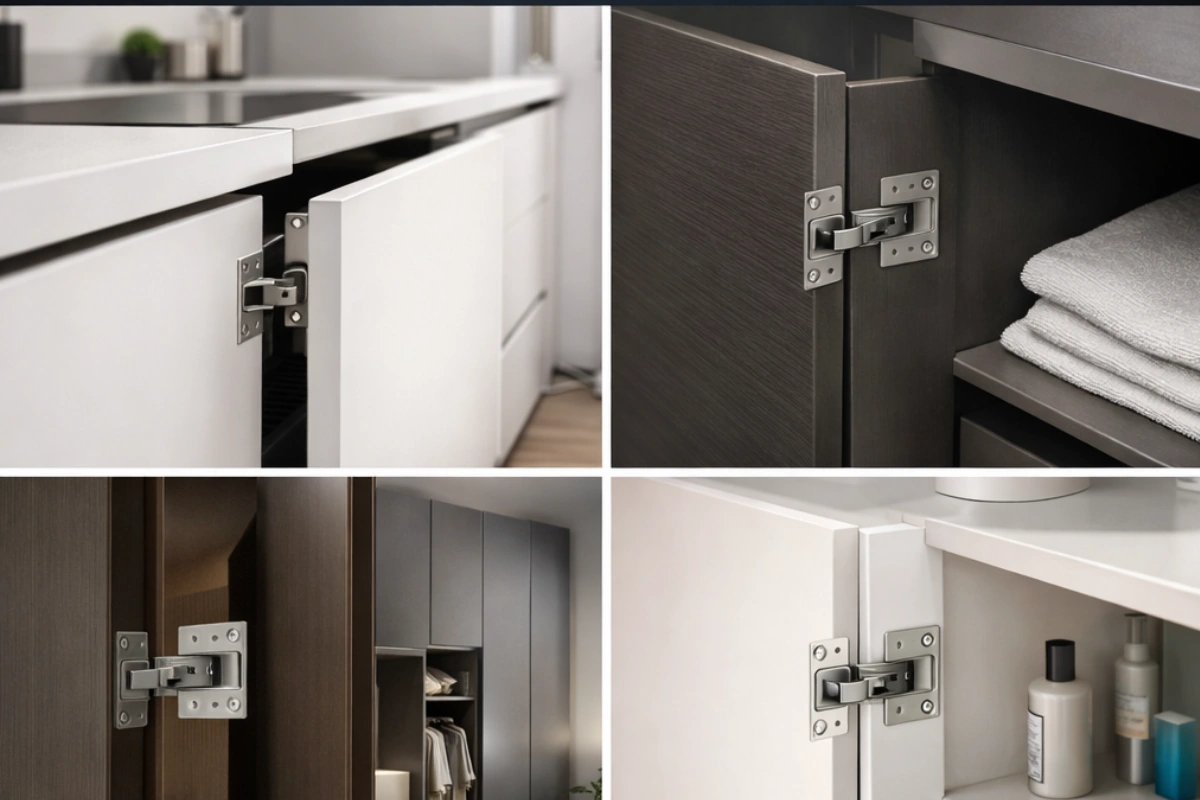
- 110° Concealed Hinges: The standard for flush-to-wall cabinets.
- 155° Wide-Angle / Zero-Protrusion Hinges: These are critical for cabinets with internal pull-out drawers. A standard hinge leaves the door slightly in the way of the drawer track; a zero-protrusion hinge clears the path completely.
- Concealed Pivot Hinges (for Jib Doors): When creating a “secret room” or a hidden walk-in closet in a villa, use pivot hinges that are recessed into the top and bottom of the door. This allows a heavy stone-clad or wood-paneled door to swing without any visible side-hinges.
3. Kinetic Mastery: Movement Systems
How the storage moves defines the “smart” experience.
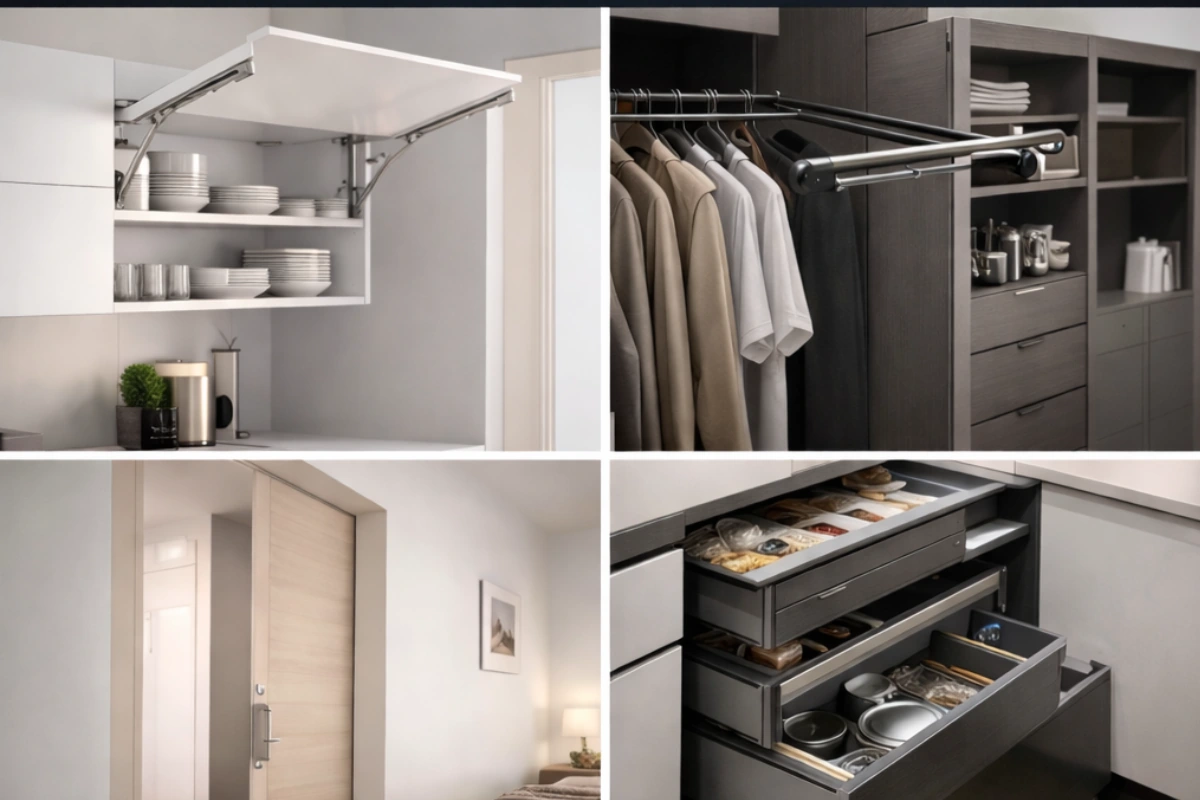
- Pivot-Slide (Pocket) Doors: These are the “Holy Grail” of 3BHK and Villa design. The door opens and then slides back into a pocket on the side of the cabinet. This allows you to keep an “Appliance Garage” or “Home Office” open during the day without the doors blocking traffic.
- Copalent / Planar Sliding Systems: Unlike traditional sliding doors that overlap (leaving one side always “forward”), planar systems allow doors to sit flush in the same plane when closed. When you open them, one door pops forward and slides over the other. This creates a perfectly flat wall aesthetic.
4. Interior Precision: The "Dark Mode" Aesthetic
If the exterior is silent, the interior should be sophisticated.
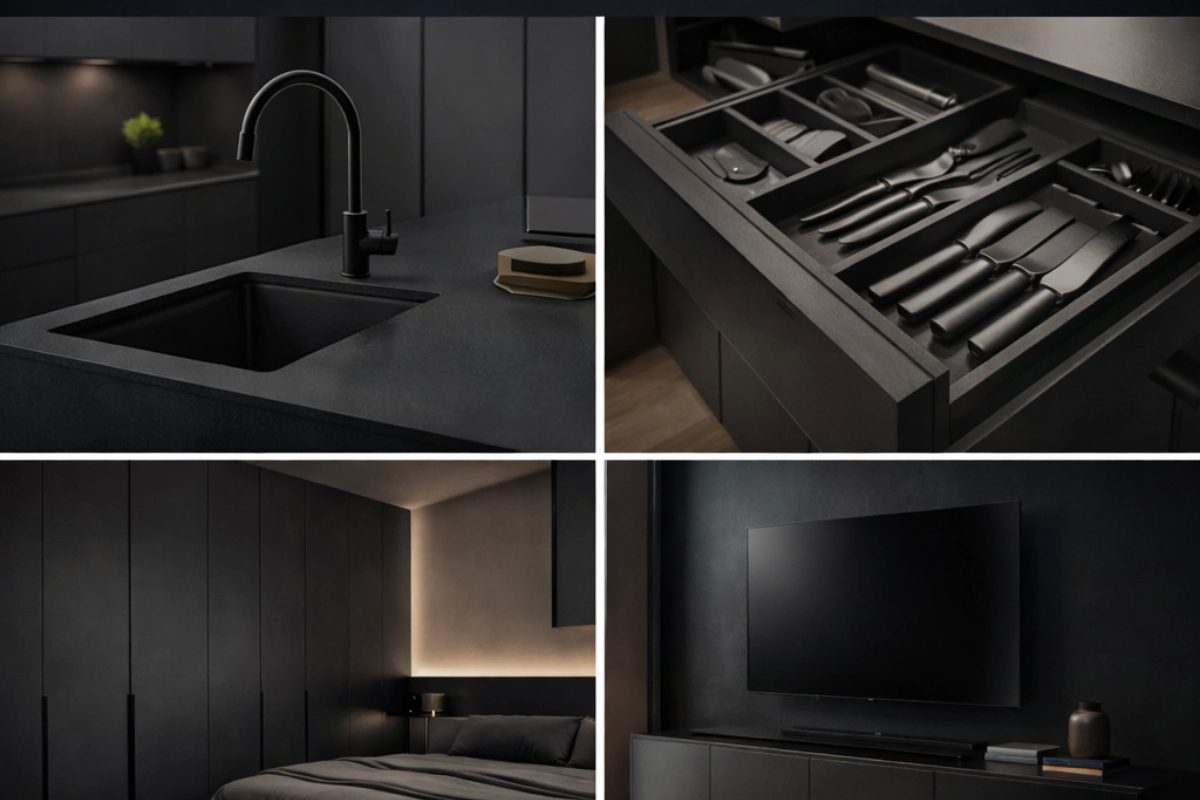
- Recessed COB LED Strips: Instead of a single bulb, use continuous LED strips recessed into a 45-degree channel. Use Door-Trigger Sensors so the light only activates upon opening.
- Graphite or Onyx Hardware Finish: Avoid “shiny chrome” inside high-end cabinetry. Use dark-toned hardware (Anthracite or Black) to ensure the hardware doesn’t “pop” visually when the door is opened.
A Storage Audit is a systematic way to look at your floor plan not as “rooms,” but as cubic volume. Most people look at the floor, but the secret to “invisible” storage is looking at the walls and the “dead zones” between functions.
Here is a high-precision checklist to help you identify hidden storage solution potential in your home.
The Precision Storage Audit Checklist
1. The Vertical "Dead Zone" Audit
- The Lintel Gap: Look at the space above your doors. Is there 12–18 inches of empty wall?
- Solution: Install a continuous “bridge” cabinet that connects wardrobes across the room, creating a seamless architectural line.
- The Full-Height Test: Do your current wardrobes stop 6 inches before the ceiling?
- Solution: Close the gap with custom soffits. This eliminates dust traps and provides space for “long-term” storage (suitcases/tents).
- The Toe Kick/Plinth Area: Look at the bottom 4 inches of your kitchen and wardrobes.
- Solution: Replace static plinths with “Toe Kick Drawers.” These are perfect for flat items like baking trays, step ladders, or extra floor tiles.
2. The Architectural "Void" Audit
- The Pillar Flanks: Do you have a structural pillar that sticks out from the wall?
- Solution: Build “shallow shelving” flush with the pillar. Cover it with a mirrored door. It’s the perfect “invisible” medicine cabinet or spice rack.
- Under-Stair Geometry (Villas/Duplexes): Is the space under your stairs walled off or empty?
- Solution: Use “Pull-out Pantries” on heavy-duty tracks. Instead of one big dark closet, create 3-4 vertical drawers that slide out to reveal your entire shoe or pantry collection.
- Window Silis: Are your window sills just narrow ledges?
- Solution: Extend the sill into a “Box Bay Seat.” This adds a furniture element (seating) while hiding a deep chest for linens or toys.
3. The "Function-on-Function" Audit
- The Bedroom Floor: Is your bed sitting on four legs?
- Solution: Switch to a Hydraulic Lift-up Base. This provides roughly 40–60 cubic feet of storage equivalent to a second wardrobe without taking up a single extra square inch of floor space.
- The Foyer Wall: Is your entryway just a plain wall with a mirror?
- Solution: Design a 6-inch Deep Console Wall. It looks like a decorative paneled wall but opens to reveal charging stations, key hooks, and a vertical shoe rack.
- The Kitchen Backsplash: Is your backsplash just tile?
- Solution: Install a “Mid-way Track.” Sliding panels can hide shallow niches for spices, knives, and oils, keeping the main counter “Magazine-Clean.”
Building a Living Platform is the most effective way to solve the storage crisis in a 1BHK. By raising the floor, you essentially create a 50–70 sq. ft. “horizontal wardrobe” that occupies zero additional floor space.
Here is the high-precision technical brief you can hand over to an interior designer or a site supervisor.
Technical Brief: The "Living Platform" (1BHK Optimization)
1. Core Concept & Dimensions
The platform is designed to house a standard Queen or King size mattress while providing deep-access storage for bulky items (luggage, seasonal bedding, etc.).
- Platform Height: 15 to 18 inches (380mm to 450mm).
- Note: Any lower and suitcases won’t fit vertically; any higher and it becomes difficult to step onto.
- Step Height: If the platform is 18″, include a single integrated step at 9 inches.
- Clearance: Ensure at least 6.5 feet (2000mm) of vertical head-space remains from the top of the platform to the ceiling to avoid a claustrophobic feel.
2. Structural Zoning (The Internal Grid)
The platform should be divided into three distinct zones based on the frequency of access:
| Zone | Access Type | Usage |
|---|---|---|
| Zone A (Outer Perimeter) | Deep Drawers (Heavy-duty slides) | Daily use: Extra linens, shoes, gym gear. |
| Zone B (Central Core) | Hydraulic Lift-up (Top-access) | Occasional: Extra mattresses for guests, festive decor. |
| Zone C (Wall Flank) | Trap Doors (Flush-latched) | Rare: Large suitcases, travel gear, moving boxes. |
3. Material Specification List (The BOQ)
- Primary Framework: 19mm Boiling Water Resistant (BWR) Plywood. (Avoid MDF/HDF for platforms as they lack structural load-bearing capacity for walking).
- Support Ribs: Vertical supports every 12 to 16 inches. These act as the “walls” for your storage compartments.
- Top Surface: 19mm BWR Plywood topped with a 3mm cork underlay (for sound dampening) before applying the final laminate or engineered wood floor.
- Edge Finishing: 2mm PVC Edge Banding (machine-pressed) to prevent chipping on drawer edges.
4. Hardware for "Visual Silence"
To maintain the “invisible” look, the platform must not have visible handles that you could trip on.
- Drawer Slides: Bottom-mounted / Under-mount synchronized slides. These stay hidden under the drawer box and can support up to 40-60kg.
- Lift-up Mechanism: Gas Spring Hydraulics (60kg to 100kg force depending on the weight of the top ply and mattress).
- Handle Style: Finger-pull grooves (J-profile) or flush-recessed ring pulls that sit level with the wood surface.
5. The "Invisible" Designer Tips
- Ventilation: Drill 20mm air-holes in the internal support ribs. This prevents the “musty smell” that often occurs in sealed floor storage.
- LED Wash: Install a recessed LED strip in the toe-kick (the bottom 2-inch undercut). This makes the massive platform look like it is “floating,” making the 1BHK feel lighter and larger.
- Material Match: Ensure the vertical sides of the platform match the color of your room’s wardrobes to create a continuous “wrap-around” visual effect.
Conclusion
Integrating these high-precision smart storage solutions requires a delicate balance of engineering, material science, and aesthetic intuition. While the principles of Visual Silence are clear, the execution from calibrating hydraulic pressure to ensuring seamless J-profile joinery is where the magic truly happens. You don’t have to navigate these technical complexities alone.
At Homzinterio, our skilled designers are experts in “engineering volume,” specializing in transforming standard floor plans into sophisticated, clutter-free sanctuaries. We take the trouble out of the technicalities, ensuring that every inch of your home is optimized with the precision and elegance your lifestyle deserves.